

ComputeLabs Research · Insights
Where the GPU Credit Crunch Actually Is
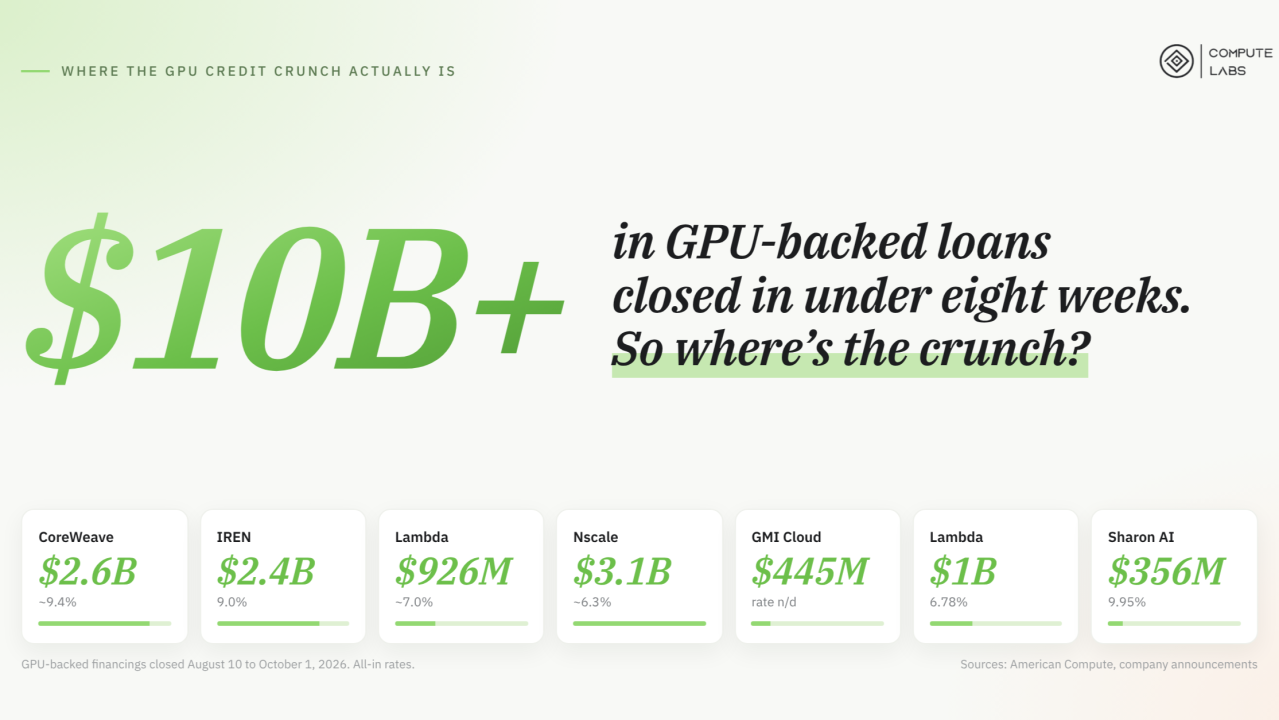
More than $10 billion of GPU-backed loans closed in eight weeks this fall: lenders are still funding signed contracts, just not neocloud corporate debt, and they give GPUs almost no value once those contracts end.
Published
Authored by Warren Hosseinion Jr.
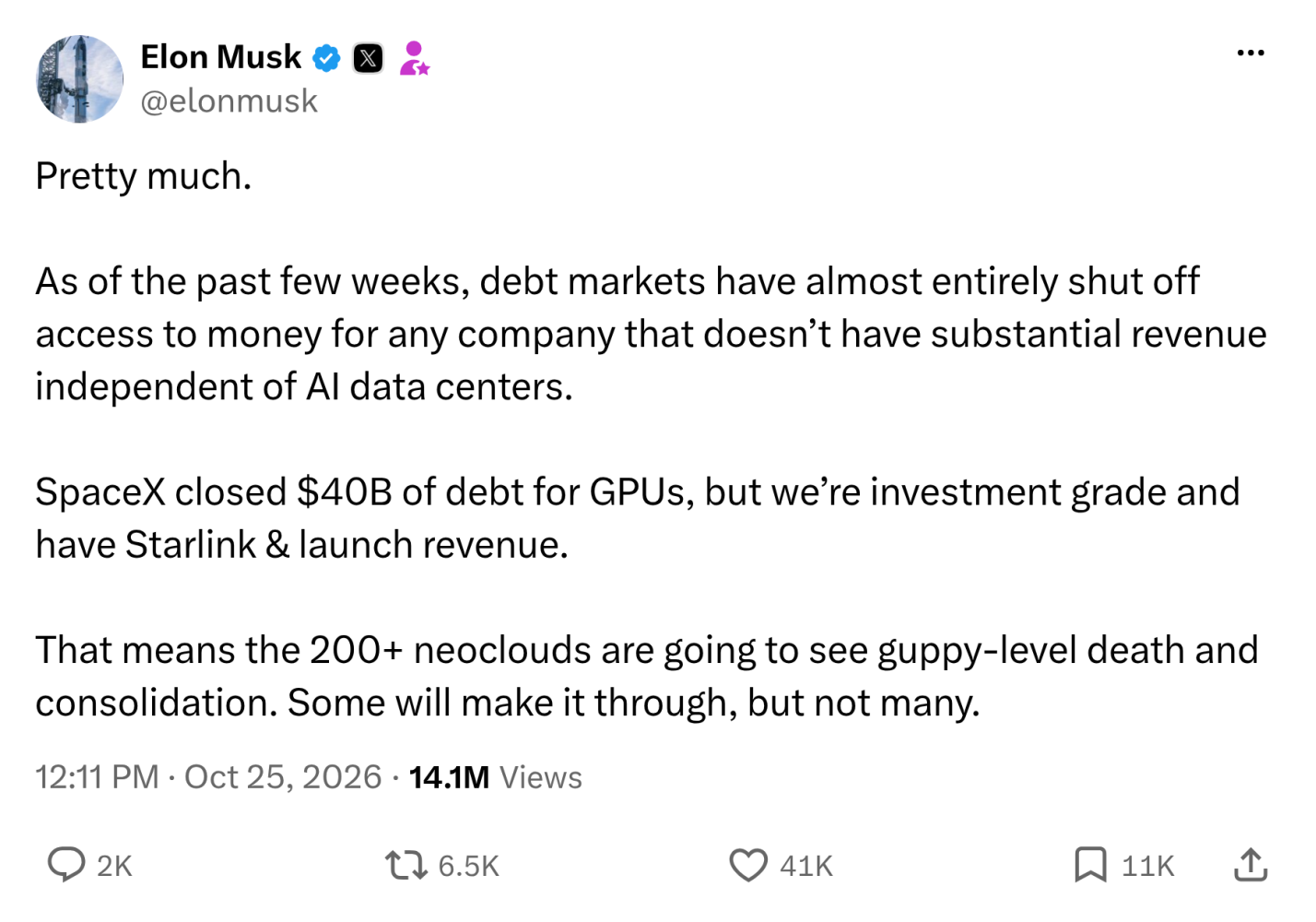
On October 25, Elon Musk wrote that lenders had all but stopped funding neoclouds, the newer cloud companies that rent out GPUs, if they don't earn much outside AI data centers.¹ In the same posts he said SpaceX had closed a $40 billion GPU loan, though Bloomberg reported it was still being negotiated.²
CoreWeave is the biggest neocloud, and its cost of capital rose sharply in October. Its shares fell about 36% over the month, its 9.75% unsecured notes due 2031 traded down to yield about 16%, a level the market reserves for high-yield credits, and S&P rates it B+, below the investment-grade line that keeps many pension funds and insurers out of its debt.³
None of that means CoreWeave's customers stopped paying, though. Its backlog of signed contracts grew from $104 billion in August to about $132.5 billion at the end of September, and third-quarter revenue rose 168% from a year earlier.⁴ ¹³ The 16% is what investors demand on CoreWeave's unsecured notes, which have no lien on GPUs or customer contracts and rank behind the loans that do, so their buyers are underwriting the whole company. On its November 10 earnings call, CoreWeave said it won't fund itself in the unsecured debt market at current yields and doesn't need to. Its contract-backed term loans price from 2.25 to 5.5 points over SOFR depending on the customer behind them, with investment-grade customers at the low end.¹³ Equity markets tightened across the sector too with Firmus's withdrawal of its IPO, and Nscale's raise at a lower valuation than it first sought.³
Asset-level financings tied to a signed offtake contract are a different story, because the lender is underwriting the contract and the offtaker’s credit more than the borrower’s.
Where lenders are still saying yes
More than $10 billion of GPU loans closed between August 10 and October 1, right up to the October selloff in neocloud stocks.⁵ Each is secured by GPUs and most are backed by specific offtake contracts, though structures vary: some are non-recourse to a deal-specific SPV, and some also carry a parent guarantee. Rates below are all-in, with floating-rate loans converted at October's average SOFR of about 3.9%.¹¹
- Lambda, a $926 million senior secured term loan B led by Morgan Stanley on August 27, at about 7%. It's backed by the GPUs and cash flows of one deployment for an investment-grade offtaker, and Moody's rated it Baa2, investment grade.⁶
- Nscale, $3.1 billion across two delayed-draw term loans led by JPMorgan and Goldman Sachs on August 31, at about 6.3%, each tied to a specific data center site.⁵
- Lambda again, a roughly $1 billion fully amortizing delayed-draw term loan from JPMorgan at a fixed 6.78%, reported October 1.⁵
- IREN, $2.4 billion from Blue Owl and Pimco on August 25, at a fixed 9%, in tranches that amortize over 30 months.⁵
- CoreWeave, a $2.6 billion delayed-draw term loan from JPMorgan and MUFG on August 10, at about 9.4%, secured by GPUs and contracts with a parent guarantee.⁵
- Sharon AI, a $356 million senior secured SPV facility on October 1 at a fixed 9.95%, with Goldman Sachs among the lenders.⁷
- GMI Cloud, $445 million from Taiwan's CTBC Bank on September 30.⁵
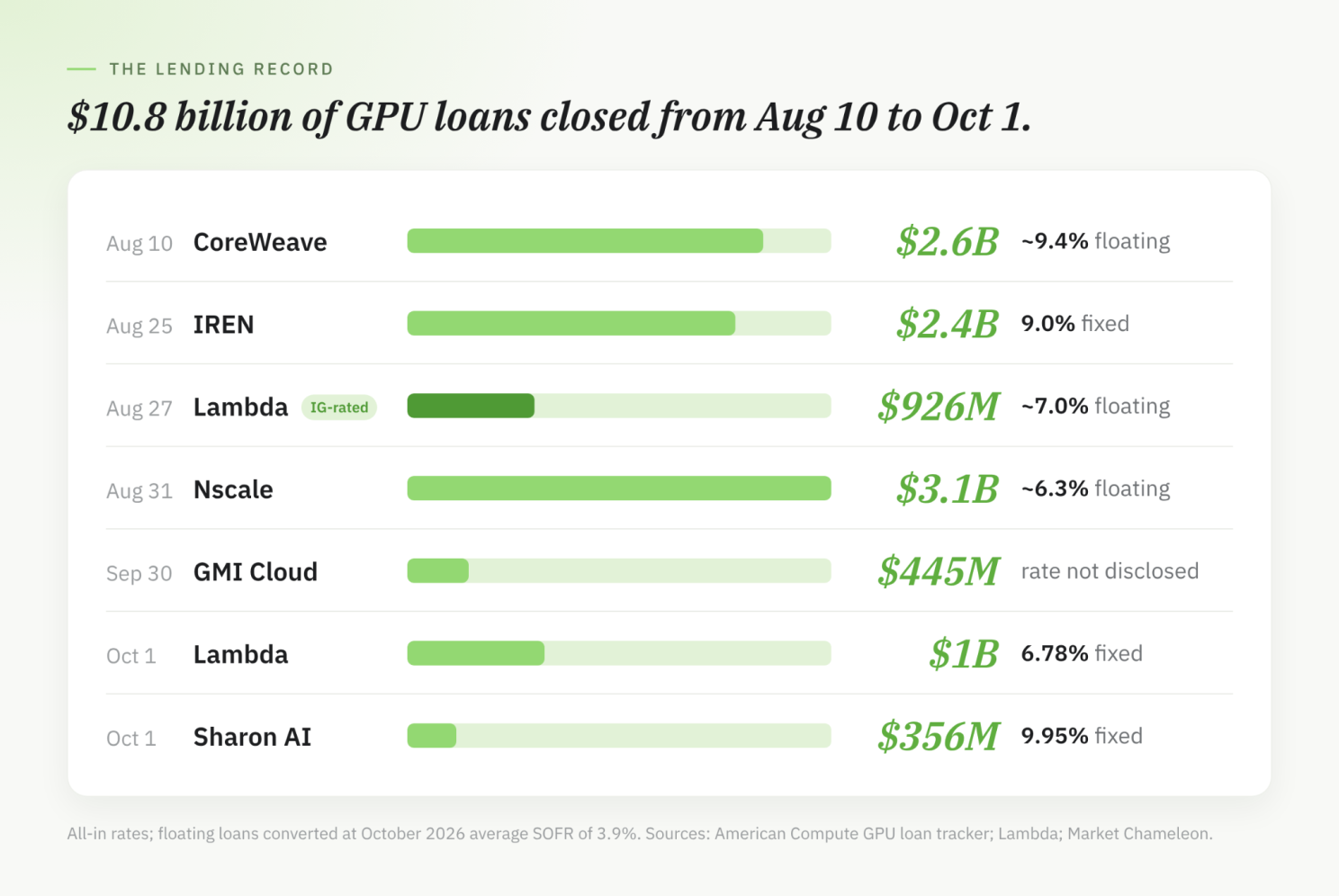
Pricing ran from about 6% to 10%, with Lambda's investment-grade-rated deal near the bottom of that range. Three of the loans are floating-rate, and for all the credit crunch talk since, their spreads of 2.375 to 5.5 points over SOFR are relatively modest.⁵ The average large private credit loan priced about 5.2 points over SOFR in September.¹⁴ Private credit lenders also issued Compute Labs term sheets in September and October on three smaller clusters with take-or-pay offtake, priced from 10% to 13.5%.
Corporate lending hasn't shut down either. On October 22, Citi gave Nebius a $3.5 billion, 364-day bridge loan at SOFR plus 2.75%, about 6.6% all-in and a quarter point wider than its July facility. Nebius said it can term out the bridge with asset-backed financing against more than $40 billion of contracts with investment-grade customers.⁸
Musk's warning really applies to a much narrower group of companies. Lenders are pricing each borrower on the quality of its contracts and the size of its near-term maturities, and as of October no neocloud had publicly defaulted on a loan backed by GPUs.⁹
What lenders ask for
Since launching the Compute Labs Financing Platform this fall, we've already secured term sheets from five lenders on three GPU deals. Here's what each deal looks like, with the parties left out and the terms rounded.
All three deals are set up the same basic way. The GPUs sit in a deal-specific SPV, the offtaker pays into it, and a cash waterfall pays debt service before anything reaches the sponsor, the company that owns the deal and put in the equity. The deal keeps running as long as the customer keeps paying, whatever happens at the parent company level.
The first deal has a three-year take-or-pay contract and a three-year loan to match. The lender advances almost 85% of what the GPUs cost, which comes to about 70% of the total project. The offtaker prepays about 12%, and the sponsor funds the rest as equity. Debt service takes about three-quarters of contracted revenue each month. The loan doesn't fully pay off, though. About a tenth is left as a balloon at maturity, and the lender required residual value insurance on the GPUs to cover it, with itself named as loss payee.
The second deal has a five-year contract, and two lenders bid on it. One offered a three-year loan for 55% of project cost, repaid in 12 equal quarterly installments, so it's gone two years before the contract ends. It also wants a debt service reserve, $3 million of cash on hand, and a 50% cash sweep, which sends half of any leftover cash to paying the loan down early. The other lender offered a longer loan that pays down 5% a quarter and has to be fully repaid six months before the contract ends. Both want a large offtaker prepayment before they'll fund.
The third deal is the largest. It also has a five-year contract and two lenders, and both offered four-year loans that pay off completely, with no balloon. That leaves a full year of contract after the debt is gone. The customer here prepaid close to half the project cost and agreed not to claim any of it back until the loan is repaid.
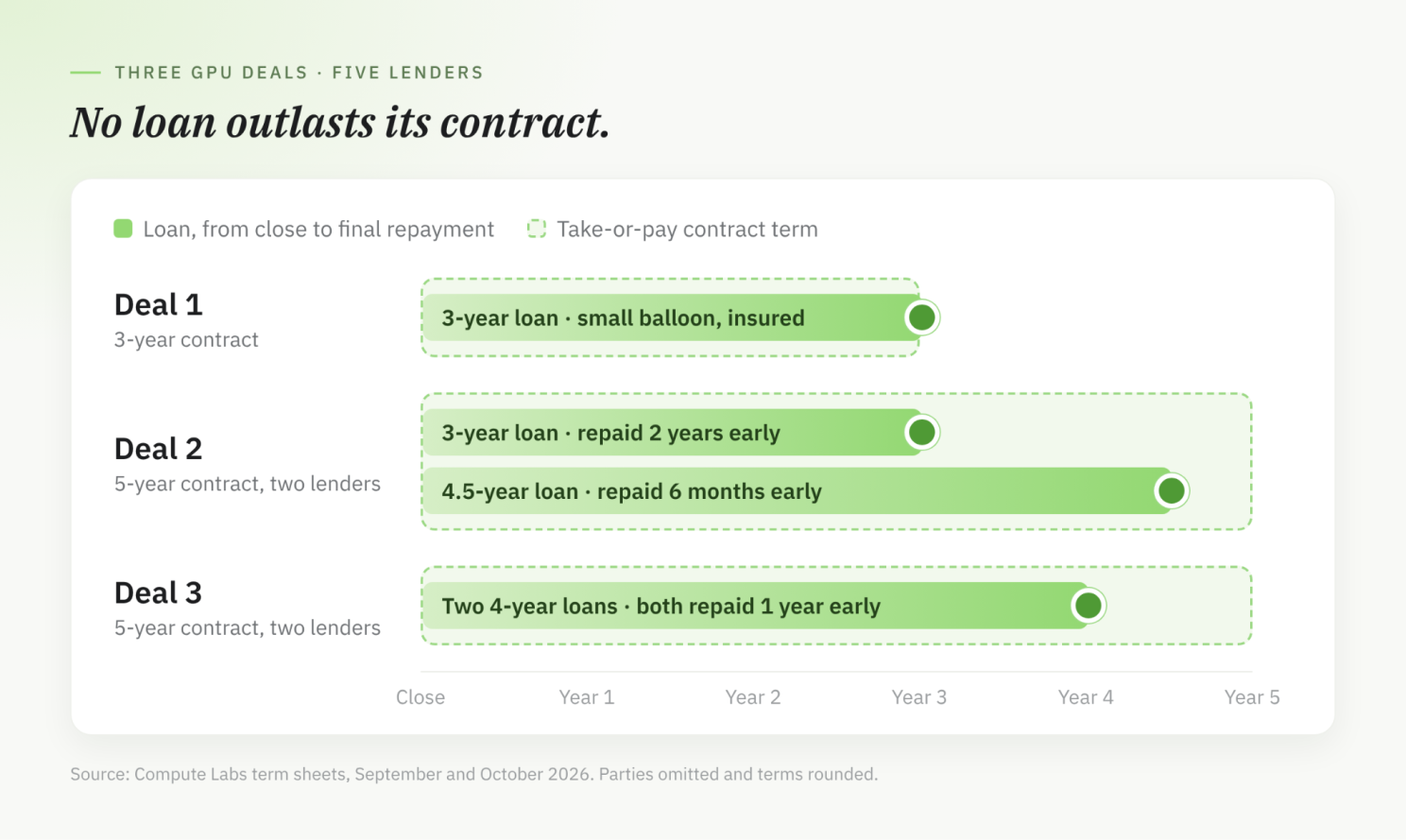
So no loan in any of the three deals runs past the customer's last contracted payment. Lenders are putting up roughly 55% to 70% of the cost, and customers and sponsors cover the rest. A customer doesn't prepay half a project unless it needs the capacity and can't easily get it somewhere else. Pricing ran from 10% to 13.5%.
The other protections mostly deal with the customer leaving. If it ends the contract early, the full loan comes due, though two of the lenders give the sponsor 60 days to sign a replacement customer on no worse terms first. The lender on the first deal also tests GPU residual value as a performance trigger, and one on the second requires the deal's cash flow to cover its loan payments by a margin that steps up from 1.10x to 1.30x.
The residual value lenders don’t count
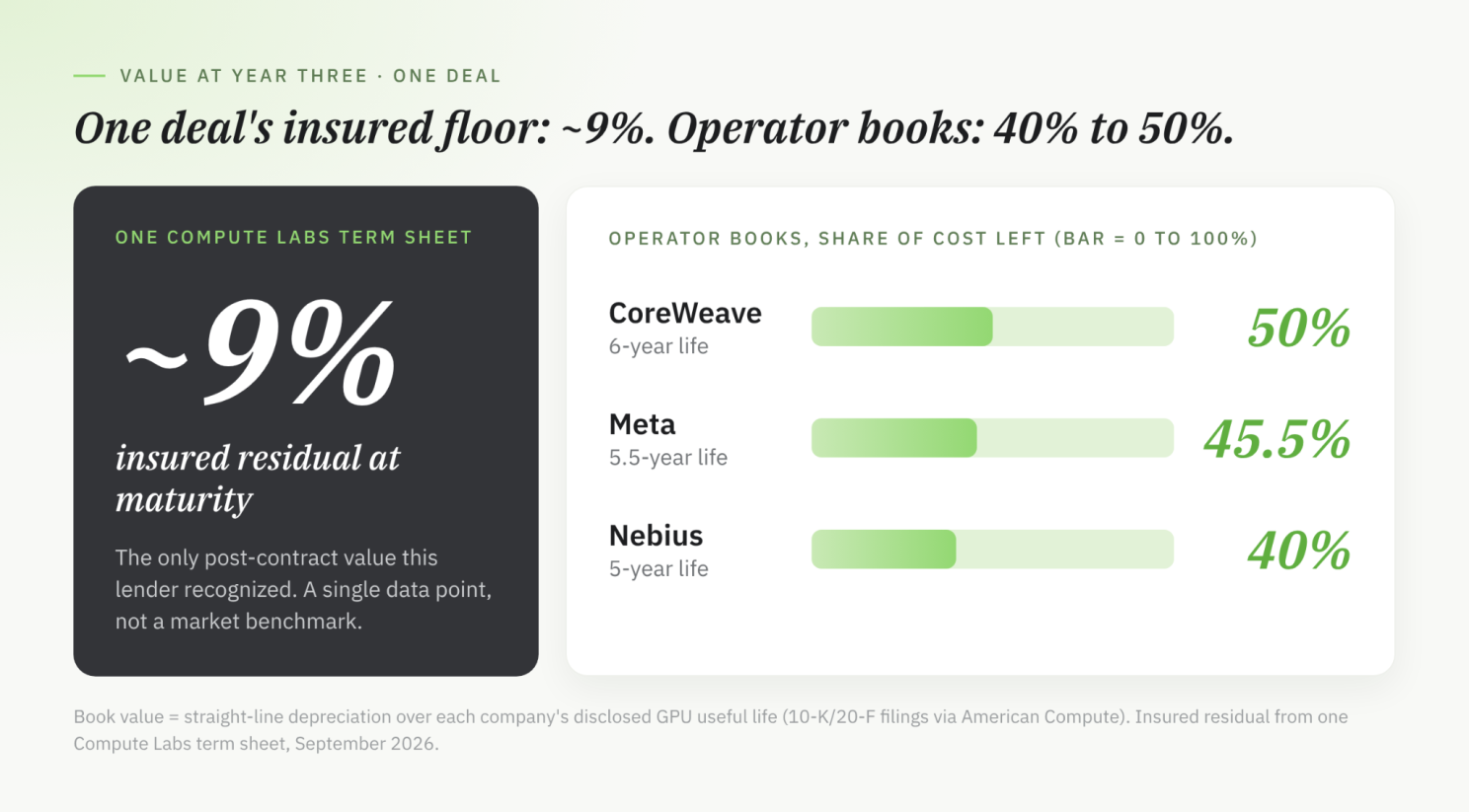
Every one of these term sheets is built so the contract alone repays the loan, with no reliance on what the GPUs are worth once it ends. The only post-contract value any of the lenders recognizes is the residual value insurance on the first deal: if the GPUs sell for less than about 9% of their original cost at maturity, the insurer covers the shortfall, which is enough to clear the balloon. An earlier term sheet on the same deal, with no insurance behind it, offered 70% of GPU cost. This one, with the insurance, went to almost 85%.
Companies that own and run GPUs value them very differently. Public operators depreciate their chips over five to six years, because that's how long they expect them to keep earning. On a six-year schedule like CoreWeave's, half the original cost is still on the books at year three; Meta uses five and a half years, and Nebius moved from four to five in January.¹⁰ The gap between the 40% to 50% operators carry and the roughly 9% that lender recognized is value the lender simply didn't count.
Lenders count so little because the market for used data center GPUs is still young. On the first two deals, lenders asked what the GPUs would be worth once the contracts ran out, and no one could give them a firm number. Silicon Data and American Compute both publish residual value estimates, each built from a different angle: Silicon Data from the income a chip can still generate, American Compute from recent sales. Both are useful reference points, but neither yet has the years of trading history a lender wants before advancing against it, so the conservative choice is to underwrite zero or transfer that risk to an insurer.
Lenders still watch the hardware closely during the loan, even while giving it no credit for repayment. One lender tests its loan-to-value every quarter against secondary-market prices and broker quotes for the same 8-GPU servers, and wants an independent forward residual value curve before it funds. Another gives the sponsor 60 days to re-contract the GPUs after losing a customer before it can sell them through an IT asset disposition firm. A lender only offers 60 days to re-lease capacity if it expects someone else to want it.
Whatever lenders won't count stays with the owner. Every dollar a GPU earns or sells for after its contract accrues to the equity, because contracted revenue already retired the debt.
Old GPUs have never been worth zero
The closest precedent for what financed computing hardware is worth in a downturn is the 2022 bitcoin mining crash. Miners had borrowed against ASICs, machines built only to mine bitcoin. When bitcoin price fell, they couldn't service their loans. Their lenders had to collect on the machines, and that was the first real test of what seized computing hardware is worth.⁹
How much lenders got back came down to whether the machines kept running. Lenders who took the hardware back recovered a third to two-thirds of what they were owed: BlockFi accepted $7.75 million to settle $21 million owed by Bitfarms, about 37 cents on the dollar, and NYDIG repossessed 27,403 Core Scientific miners against a $38.6 million loan and recovered roughly 65% of it in machines. Lenders whose borrowers kept operating did far better. Core Scientific's equipment lenders came out of Chapter 11 with stock or new loans worth 80% of their claims, and NYDIG was repaid in full after Argo sold its Helios facility to Galaxy.⁹
Treat the miner recoveries as a floor. They're measured against loan balances rather than original hardware cost, and they come from machines that could do only one job, seized in the middle of a crash.
A GPU has far more buyers than an ASIC ever did. In our last piece we showed that every retired data center GPU generation ran seven to nine years in revenue service, and that CoreWeave has an A100 contract running into 2029, the chip's ninth year.⁴ On the same August call, CoreWeave's CEO said pricing for prior-generation chips was "at or above where it was years ago." On the November call, he said the company's original fleet is "re-contracting at premiums."¹³ In that deal, a lender counting 9% at year three was pricing five or six more years of rentable life at close to nothing.
What we expect
Over the next year, we expect contract-backed GPU financings to keep getting done at rates in the low teens, while corporate credit for neoclouds stays wider than it was this summer. The real test of what GPUs are worth will come whenever hardware changes hands outside a contract, through a sale or a merger. We expect those GPUs to sell well above the near-zero lenders count today, and anyone can check that against the used market now. More than six years after launch, used A100s are already selling for 19% to 94% of their inflation-adjusted launch price, with the 80GB versions at 34% or more, based on sales over the past three months.¹²
Insurers will be the first to put a public price on GPUs after their contracts end. Every sponsor that buys residual value insurance to tighten its loan pricing forces an underwriter to price those years, and over time those premiums will become the price curve lenders say doesn't exist yet.
If you're an insurer or reinsurer that can underwrite residual value on GPU deals of $100 million or more, we'd like to hear from you.
Sources
- Musk says SpaceX closed $40 billion GPU debt deal, predicts neocloud shakeout, investingLive, October 26, 2026.
- Musk claims $40 billion chips debt closed, yet talks ongoing, Bloomberg, October 25, 2026.
- Neocloud stocks are being repriced as credit risks, Top1Markets, October 2026.
- Nine Years of A100s: A Review of How Long GPUs Earn, Compute Labs, citing CoreWeave's Q2 2026 earnings call (August 11, 2026) and Azure deprecation notices.
- Largest GPU-backed loans (2026), American Compute, compiled from company filings and announcements.
- Lambda closes $926 million senior secured term loan B facility, Lambda, August 27, 2026.
- Sharon AI taps a US$356m GPU-backed debt facility at 9.95%, Market Chameleon, October 1, 2026.
- Nebius borrows $3.5 billion as investors question neocloud debt, TheStreet, October 22, 2026.
- GPU and neocloud defaults: every public case, American Compute, October 2026.
- GPU depreciation schedules, American Compute, compiled from company 10-K and 20-F filings.
- SOFR, October 2026, sofrrate.com. October average 3.90%.
- Used GPU prices and collateral valuation, CCIR, executed eBay sale medians as of November 2, 2026 (trailing 90 days); percentages are of CPI-adjusted launch list price.
- CoreWeave Reports Strong Third Quarter 2026 Results, CoreWeave, November 10, 2026, and its Q3 2026 earnings call transcript, Investing.com.
- Monthly Insights & Outlook: At a Glance (October 14, 2026), KBRA DLD. Private large-cap loan spreads were S+516 in September 2026.
Originally posted on LinkedIn by Compute Labs.