

ComputeLabs Research · Insights
Nine Years of A100s: A Review of How Long GPUs Earn
GPUs stay in service as long as they earn more than they cost to run. The public record shows they keep earning for years longer than the market expects; it shows demand for compute is long tailed.
Published · updated
GPUs stay in service as long as they earn more than they cost to run. The public record shows they keep earning for years longer than the market expects; it shows demand for compute is long tailed.
Authored by Warren Hosseinion Jr.
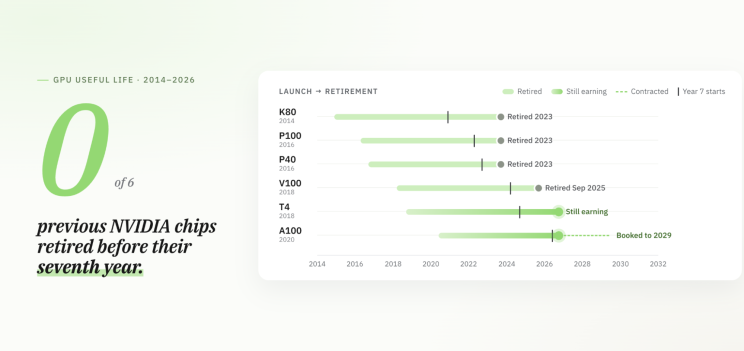
On its Q2 2026 earnings call, CoreWeave disclosed an A100 contract that runs into 2029. NVIDIA announced the A100 in May 2020, so the contract reaches into the chip's ninth year, three times the two to three years Michael Burry argued in November 2025 that a GPU realistically lasts.¹ ⁹ Burry used that estimate to claim hyperscalers were understating depreciation by roughly $176 billion from 2026 to 2028.⁸
CoreWeave CEO Mike Intrator said on the call that pricing for prior-generation SKUs is "at or above where it was years ago," and CFO Nitin Agrawal said average selling prices for older generations have held at or above prior-year levels. With $2.58 billion of quarterly revenue and a $104 billion backlog, CoreWeave has more demand than its new hardware can serve, and it is keeping six-year-old A100s under contract because customers still buy the hours.
Any GPU cluster that is economically viable to operate will be operated. If the chips earn more than they cost to power, run, and maintain, the owner keeps them on, whatever their age. They keep earning more than they cost because demand for compute is long-tailed. It arrives as a significant number of small, unpredictable jobs from customers who cannot commit to multi-year capacity.
What happened to the earlier generations
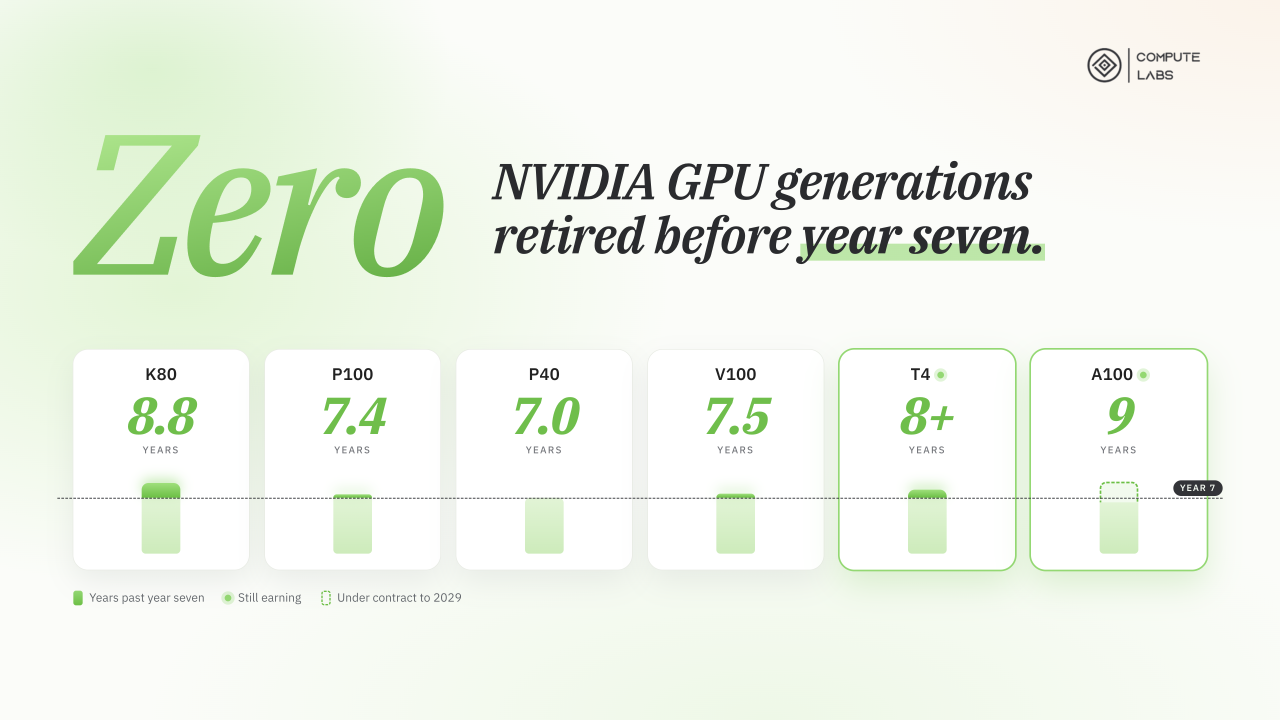
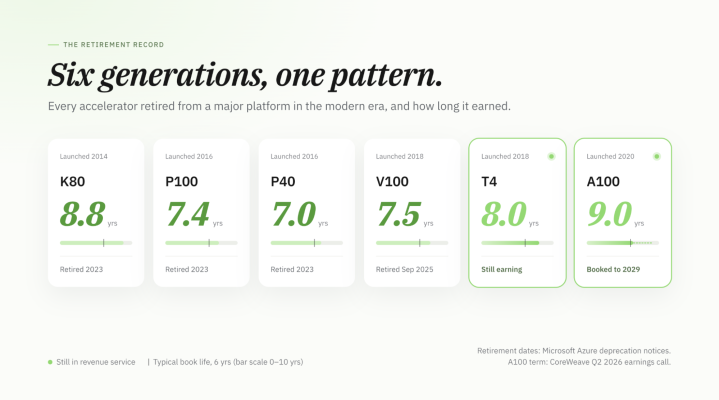
Azure retired its V100 virtual machines in September 2025. The V100 launched in early 2018, so it earned revenue for about seven and a half years. Azure retired its K80, P100, and P40 instances in 2023. Those chips shipped between 2014 and 2016, so each ran seven to nine years. The T4 launched in September 2018 and still earns rental revenue today.²
These dates come from public deprecation notices that almost nobody reads as a dataset. Together, they show that no GPU generation in the modern era has been retired anywhere near the three-year mark that standard financial models assume. The largest operators disclose useful lives of five to six years.³ Every generation that has actually been retired ran seven to nine years, because customers kept renting it.
Why older GPUs keep earning
Two things keep an older GPU earning. The first is demand. As of early 2026, A100s rent for $1.29 to $3.43 per GPU-hour depending on the provider. On many inference jobs, an H100's extra speed does not shorten the job in proportion to its higher price, so the older chip finishes the job at a lower cost per task.² That demand comes from several sources that add to each other. Inference and fine-tuning work is at an all-time high. New cloud operators buy used GPUs because they lack the capital and supply allocation to start on the newest chips. Cheaper compute makes new uses worth running. Research and applied science use more compute every year without needing the newest chips. And buyers in regions where export rules restrict new chips keep buying older ones.
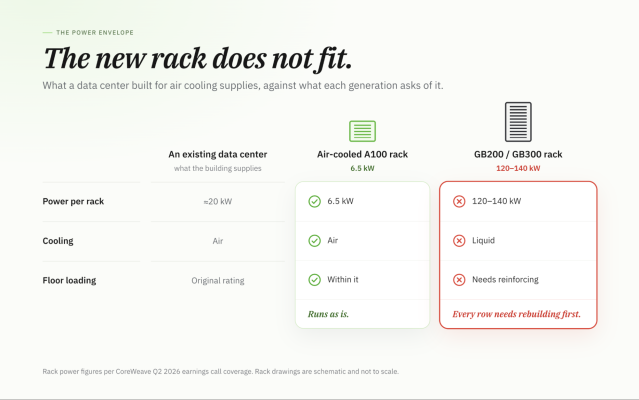
The second is the power envelope, meaning how much electricity a data center can deliver to each rack and how much heat it can remove. Most existing data centers were built for about 20kW per rack with air cooling, and an air-cooled A100 rack draws about 6.5kW. A GB200 or GB300 rack draws 120 to 140kW and needs liquid cooling piped to every chip.¹ To host one, an air-cooled building has to rebuild its power distribution, cooling plant, and floor loading. Until it does, it can run older GPUs or nothing. A building that cannot be retrofitted cheaply earns more with six-year-old chips in it than it does empty.
The alternative is to build new but new capacity is slow to arrive. Building construction alone takes years, and getting power to the site often takes longer because the grid was built for decades of slow demand growth and cannot connect new load at this pace. In Texas alone, ERCOT reported about 410 GW of large loads waiting to connect in April 2026, roughly 87% of them data centers.¹⁰ Local opposition adds to the delay, with 45 data center projects worth $68 billion blocked or delayed in the second quarter of 2026.¹¹ Every year a new facility spends waiting is another year existing buildings keep renting the GPUs they can host.
Will newer GPUs fit these buildings?
This protection lasts only as long as new GPUs need more power and cooling than older buildings can supply. NVIDIA's roadmap says they will. At GTC in March 2025, NVIDIA said its Rubin Ultra NVL576 racks, shipping in 2027 on a new rack design called Kyber, will draw 600kW. That is about four times a Blackwell rack and thirty times what an air-cooled building was built to deliver.⁵ Each generation NVIDIA has announced through 2027 needs more power per rack than the last. The gap between what older buildings supply and what new GPUs need keeps widening, so those buildings will keep running the GPUs already in them.
What would change our view is a new inference chip that runs within the power and cooling existing buildings already have, costs less per task than an A100, and needs no retrofit. A chip like that would take work from older fleets.
What this does not settle
Blackwell has not arrived in volume yet, so older-generation pricing has not been tested against a full wave of new supply. The power-envelope argument weakens if the industry builds so much high-density capacity that air-cooled buildings stop being worth filling. And rental prices have held up in a market short on supply, which may make recent pricing look stronger than it will be over time. The retirement record depends on none of this because it describes what already happened.
What this means for anyone financing GPUs
Reconsider your priors on depreciable life. No modern GPU generation has been retired anywhere near three years. The largest operators assume five to six, and every generation actually retired ran seven to nine.³ A schedule at the short end of that range is a forecast, and so far those forecasts have come in short of what the hardware did.
Price the rack, not only the chip. A building's power envelope dictates what you can install, which determines what older GPUs compete against. Two identical fleets in buildings with different power limits will have different economic lives, and almost no model captures that today.
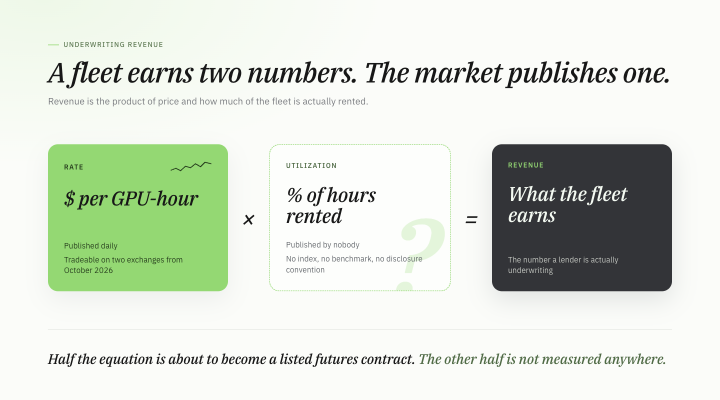
Underwrite both halves of revenue. A fleet's revenue is its rental rate times its utilization, meaning the share of hours actually rented. Operators trade one for the other, because cutting price fills more hours in any active rental market. Silicon Data's H200 index rose 14.4% between May and July 2026.⁴ An index like that tells you where the market cleared. It cannot tell you what a given fleet charged or how full it ran, and that gap signals how young this market's pricing infrastructure still is.
Our Conclusion
The question we get most often is whether we’re in a bubble. Some AI companies are valued on outcomes that have not happened yet, and some of those valuations will likely come down. That is a question about equity risk, and we have no position on it. Whether GPU spending gets paid back is a separate question, and the evidence to answer it exists. An A100 announced in 2020 is under contract into 2029, and four generations in a row stayed in revenue service for seven to nine years. Anyone who argues that GPU capital will not be recovered has to argue against that record.
Price discovery for GPU rentals is arriving quickly, with futures to be listed on two exchanges within a year most likely.⁶ ⁷ Nobody publishes utilization or residual value consistently yet. We published our own H200 fleet's actuals earlier this month, including the months with less than ideal performance. A market of this scale should not be pricing its main asset on incomplete data.
Sources
- CoreWeave Q2 2026 earnings call, August 11, 2026. Call transcript; reported in Tom's Hardware (August 12, 2026) and TechPowerUp. Rack power figures per Tom's Hardware coverage.
- Hashrate Index, Used GPU Market: A100 & H100 Pricing, Depreciation, April 8, 2026. Retirement dates per Microsoft Azure notices: NC-series (K80), NCv2-series (P100) and ND-series (P40), all September 6, 2023; NCv3-series (V100), September 30, 2025.
- The Forward View, Useful Life: The AI Depreciation Gap. Company useful-life disclosures as summarized there.
- Silicon Data, H200 Rental Price Index and H200 vs H100 Rental Prices: The Premium That Doubled. Compute Labs fleet actuals published in Thirty-Two H200s, Fourteen Months: What the Actuals Show, September 15, 2026.
- NVIDIA GTC keynote, March 18, 2025, as reported by The Register and Tom's Hardware (Kyber rack). The 600kW figure is an announced specification for Rubin Ultra NVL576 hardware scheduled to ship in 2027, not a deployed rack.
- CME Group, CME Group and Silicon Data to Launch Compute Futures on October 5, August 11, 2026. Launch subject to regulatory review.
- Intercontinental Exchange, ICE and Ornn to Launch GPU Compute Futures Contracts, May 19, 2026. Launch subject to regulatory approval.
- Michael Burry's depreciation argument, November 2025, as covered by CNBC, Deep Quarry and the National Law Review. The $176 billion figure comes from secondary coverage.
- A100 availability. NVIDIA announcement, May 14, 2020. General availability: AWS EC2 P4d, November 2020; Google Cloud A2, March 2021; Microsoft Azure ND A100 v4, June 2021.
- ERCOT, Large Load Update to the Texas House Committee on State Affairs, April 9, 2026.
- Data Center Watch, Q2 2026 report, as reported by Tom's Hardware, September 2026.
Originally posted on LinkedIn by Warren Hosseinion Jr.