

ComputeLabs Research · Insights
Thirty-Two H200s, Fourteen Months: What the Actuals Show
A retrospective on our first on-demand GPU deal: how it performed and what it taught us about where this asset class is heading.
Published · updated
A retrospective on our first on-demand GPU deal: how it performed and what it taught us about where this asset class is heading.
Authored by Warren Hosseinion Jr.
Summary
In July 2025, Compute Labs acquired thirty-two NVIDIA H200 GPUs for $1.1 million and placed them into the on-demand rental market. We invested alongside approximately 300 participants, with a senior loan financing part of the fleet.
We raised and invested capital on the thesis that GPUs were an investable asset class before that thesis had any market infrastructure behind it. At the time, there was no published index for H200 rental rates. Our senior facility was priced at approximately 15% because no lender had a basis for valuing GPUs as collateral. The investment-grade GPU financings that anchor this market today, including CoreWeave's $8.5 billion facility, priced in 2026. Every piece of market infrastructure a reader would now use to underwrite this asset arrived after we had committed capital and begun operating.
We also took the harder version of the trade. The GPU transactions being financed today are supported by multi-year contracts with creditworthy offtakers, which is what makes their revenue underwritable. This fleet earned on the on-demand market at whatever the spot rate happened to be, with utilization that varied week to week. Compute Labs committed its own capital alongside participants on those terms, and the figures below are what that produced.
Fourteen months of results:
- The fleet has generated $619,022 in revenue, net of hosting, power, and marketplace fees.
- $611,290 has been earned and $502,000 has been distributed to owners, approximately 55% of the fleet's original purchase price.
- Distributions have averaged roughly 44% annualized.
- We refinanced our senior borrowing cost from approximately 15% to 12% after eight months of performance history.
What follows is the month-by-month record, what happened to rental rates over the period, and what we took from it.
Basis of these figures
- Revenue is net of hosting, power, and marketplace fees. We take our platform fee before distribution.
- Revenue per GPU per day is monthly revenue divided by 32 units divided by days in the month. It blends price and utilization and is not comparable to a published per-hour rental rate.
- Distributions are not total returns. The 44% figure is cash distributed to owners, combining income and return of capital. It excludes any residual value in the hardware, which participants still own.
The structure
Thirty-two H200s, housed and operated by a hosting partner, rented on demand through a GPU marketplace.
All revenue figures here are net of hosting, power, and marketplace fees, meaning what arrives after the cost of operating the machines has been deducted. Our platform fee, taken before distribution, totals $11,371 through July 2026. The true economics of this deal were in ownership, not in fees.
Performance
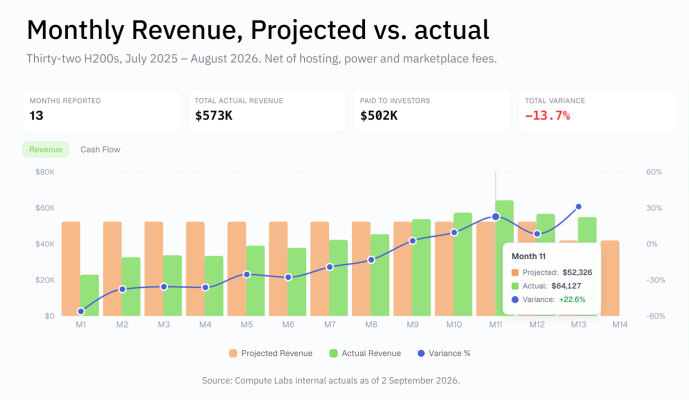
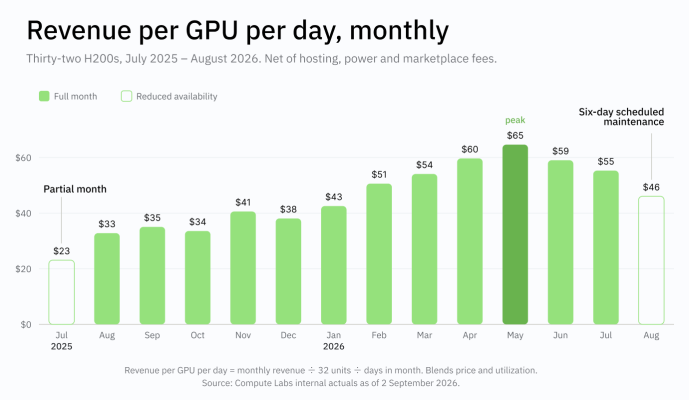
July 2025 was a partial month. Roughly half the fleet was live and earning while the remainder was still being installed and commissioned. This is the standard reality of standing up a cluster, and the reason the first month sits well below the subsequent ones.
August 2026 is the weakest month since January. A scheduled maintenance window between the 14th and 19th required all jobs to come off the units, and the fleet earned nothing for six days before returning to service. We report the month unadjusted.
What happened to rental rates
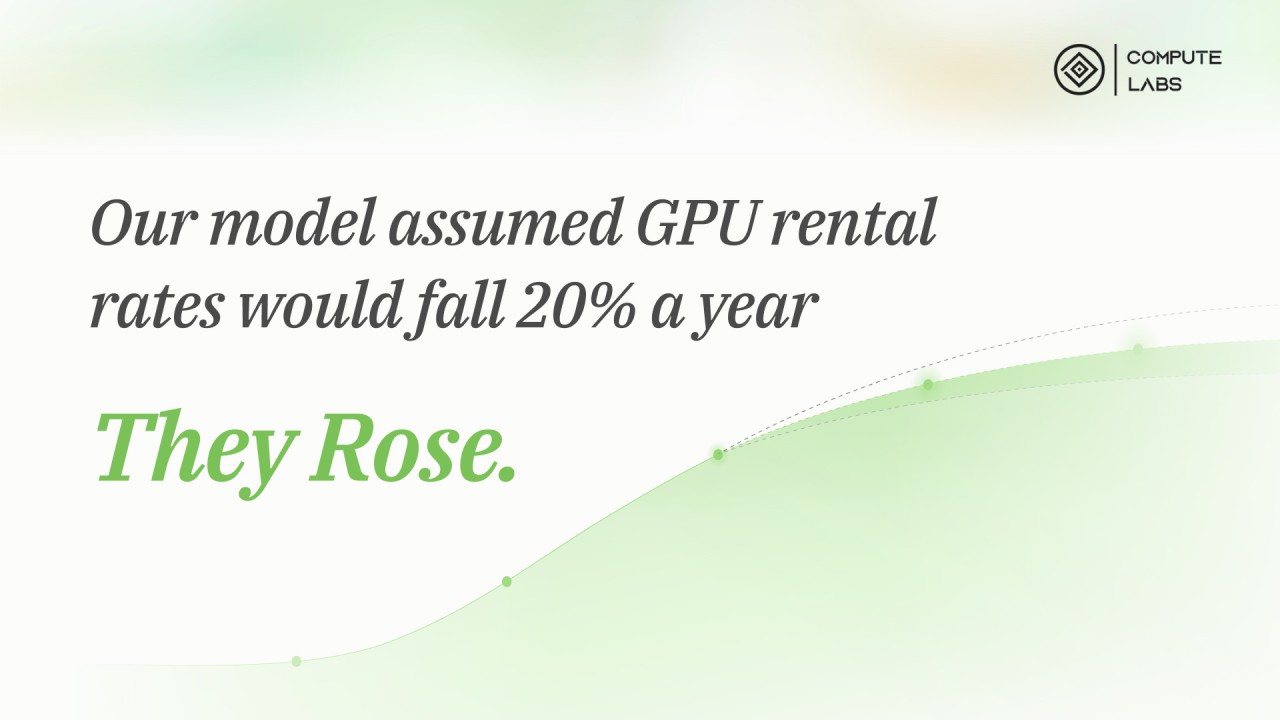
Our underwriting assumed rental rates would decline approximately 20% per year. It was intended as the conservative case.
Rates rose instead. Silicon Data's “H200 Neo-Cloud Index”, a daily benchmark of on-demand rates across a panel of neocloud providers, moved from $2.70 per GPU-hour on May 4th 2026 to $3.09 by July 27th, an increase of 14.4%. Over the same window, the premium paid for an H200 over an H100 widened from an average of 5.8% in May to 12.1% in July.¹ The index carries only a few months of daily history, so it is a directional signal rather than a settled trend, but the direction is the opposite of what our model assumed.
We attribute this to workload composition. Long-context inference is constrained by high-bandwidth memory capacity more than training is, and the H200's 141GB is often enough to hold a model on a single GPU that would otherwise have to be split across several.² We have no direct visibility into the buyer mix, so this is our reading rather than an observation.
That said, a rate index is not a revenue forecast. A fleet earns rate multiplied by utilization, and the two move independently. Our own revenue per GPU peaked in May and eased through the summer even as published rates continued to climb. Anyone underwriting this asset from a price index alone is capturing only one of the two variables that matter.
This is also one small fleet over fourteen months. Blackwell supply arriving at volume is the obvious risk to the current rate environment, and we have not yet operated through it. One qualification about the returns themselves, though. The yields described in this piece were earned in a highly supply-constrained market. This scarcity likely accounts for a meaningful part of where rates have sat. We do not assume these market conditions will persist perpetually, and fourteen months of distributions should not be perceived as a run rate.
Actually, our conviction about on-demand comes from the demand side. We believe inference demand is long-tailed: a very large number of small jobs that arrive unpredictably from customers who cannot commit to multiple years of capacity because they do not know what their own long-term needs are. That tail will grow as inference takes a larger share of total compute. We expect on-demand capacity to remain structurally necessary even as rates normalize.
What happened to our cost of capital
We borrowed against the fleet at approximately 15% in August 2025. That was the price of credit for an asset with no performance history and no established recovery assumptions.
In April 2026, after eight months of payments, we refinanced at 12%.
We are not alone in this. CoreWeave's GPU-backed facilities repriced from 15% floating in 2023 to SOFR plus 2.25% on an investment-grade-rated $8.5 billion facility by early 2026, with rating agencies underwriting the strength of the offtake counterparty rather than the hardware itself.³ At our scale, and on a far shorter timeline, the same logic applied.
We think this matters more than the yield.
A strong return tells you one deal worked. A lower borrowing cost indicates that a lender, whose entire job is to assume the worst, looked at GPU revenue and decided it was collateral worth lending against at a better price.
This shift is what an asset class needs in order to grow. Real estate only became institutional when mortgages got cheap and standardized. Compute is at the beginning of that same process, and this is what the beginning looks like.
What investing in H200s taught us
Three things we would tell anyone pricing this asset.
- Underwrite GPU-days, not a start date. Steady-state economics are the easy part of a GPU model. The deployment window is where the execution risk actually sits, and a forecast built on thirty-two units earning from day one will always overstate the first quarter. The right unit of account is units-live multiplied by days-live, with a commissioning schedule as an explicit input. Modeled that way, installation timing is something you priced rather than something you explain afterward.
- Start the yield clock at commissioning. We made two catch-up payments to participants in autumn 2025 covering the ramp period. Accruing each participant's yield from the date their share of units goes live closes that gap structurally, and it is how we would build the next one.
- Utilization is the variable nobody publishes. Rate indices are increasingly available; utilization data is not, and most operations do not track it closely. Yet a fleet's revenue is the product of the two, and over our own fourteen months utilization moved enough to break the correlation with published rates entirely. It is the single most useful metric an operator can add, and for any contracted transaction it becomes a diligence requirement rather than a preference.
What we think this means
This deal was a pilot, and it answered the question we built it to answer: whether GPUs held as an owned, financed asset and rented on demand could produce distributable cash through deployment, an outage, and a full move in market rates. Fifty-five percent of the fleet's cost has been returned to owners over fourteen months, and the fleet remains in service.
The on-demand market remains attractive. It is also a harder market to finance. Revenue is spot-priced and utilization-dependent, which means monthly cash flow carries volatility that most institutional mandates are not built to hold, as our own May-to-August variance illustrates.
The capital forming around this asset class is moving in a different direction. Clifford Chance reports that clients are asking for "new forms of contracts that are closer to long-term capacity reservation or take-or-pay compute offtake," and that GPU lease financings are now "sized to the expected contracted revenue rather than the neo-cloud's balance sheet or the theoretical resale value of the GPUs."⁴ Long-duration contracted revenue from a creditworthy counterparty converts a fleet of GPUs into something closer to an infrastructure asset, with cash flows that can be underwritten and levered on institutional terms.
That is where we are focusing next, and the value of this pilot is that it gives us fourteen months of operating history to bring to those conversations rather than a model.
The on-demand market told us the asset performs. Contracted offtake is how it gets financed.
Sources
- Silicon Data Inc., H200 vs H100 Rental Prices, May to July 2026: The Premium That Doubled, 4 August 2026. H200 and H100 Neo-Cloud Indices, daily on-demand benchmark rates.
- NVIDIA H200 Tensor Core GPU datasheet.
- Global Data Center Hub, Is CoreWeave's $8.5B Deal the GPU Asset Class Moment?, 7 April 2026.
- Clifford Chance, Data Centres & AI Compute Infrastructure Insights 2026.
All fleet performance figures are Compute Labs internal actuals as of 2 September 2026.